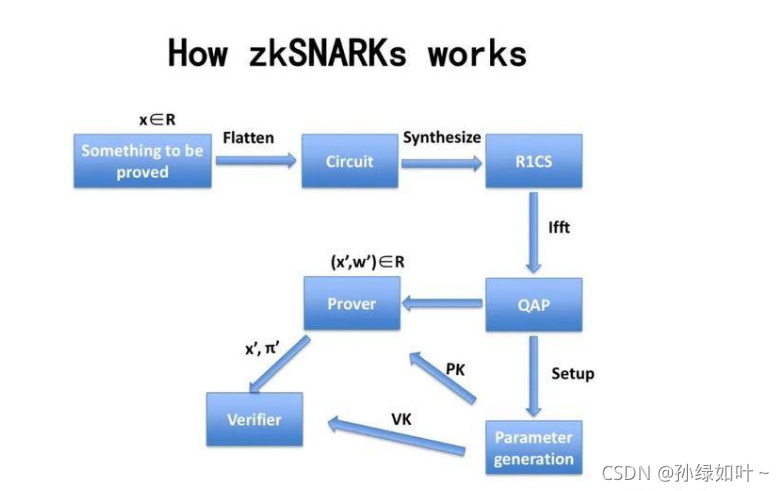
For years, privacy tools are based on the concept of "hiding among the noise." VPNs connect you to another server. Tor sends you back and forth between networks. This is effective, but they basically hide your source of information by moving it to another location, but they don't prove it does not require disclosure. zk-SNARKs (Zero-Knowledge Succinct, Non-Interactive Arguments of Knowledge) introduce a very different concept: you can show that you're authorised to do something without revealing which authorized entity that you're. In Z-Text this means that you are able broadcast a message in the BitcoinZ blockchain, and the Blockchain can determine that you're legitimate as a person with legitimate shielded accounts, but cannot identify the address you used to send it. Your IP address, identity as well as your identity in this conversation is mathematically illegible for the person watching, however confirmed to the protocol.
1. A Dissolution for the Sender-Recipient Link
A traditional message, even if it's encryption, will reveal that the conversation is taking place. An observer can see "Alice is in conversation with Bob." zk-SNARKs completely break this link. In the event that Z-Text announces a shielded transaction it confirms the transaction is legitimate--that is, that the sender is in good financial condition and keys that are correct, but does not divulge addresses of the sender and the recipient's address. If viewed from a distance, the transaction appears as a audio signal in the context of the network itself and but not from any particular participant. The relationship between two humans becomes computationally impossible to verify.
2. IP Privacy Protection for IP Addresses at Protocol Level, Not the Application Level.
VPNs and Tor ensure the security of your IP as they direct traffic through intermediaries. However these intermediaries will become a new source of trust. Z-Text's use in zk's SNARKs assures your IP address is not relevant for verification of transactions. As you broadcast your secured message on the BitcoinZ peer-tos-peer network, you belong to a large number of nodes. The zk-proof assures that even observers observe the stream of traffic on the network they won't be able to identify the packet of messages that are received with the exact wallet that created it because the authentication doesn't carry that specific information. The IP's information is irrelevant.
3. The Elimination of the "Viewing Key" Problem
Within many blockchain privacy solutions it is possible to have"viewing key "viewing key" that is able to decrypt transactions details. Zk-SNARKs that are incorporated into Zcash's Sapling protocol which is employed by Ztext will allow for selective disclosure. They can be used to verify that you sent a message without sharing your address, your other transactions, or even the whole content of the message. The evidence is what is you can share. Such a granular control cannot be achieved with IP-based systems, where the disclosure of the message inherently reveals the sources of the.
4. Mathematical Anonymity Sets That Scale globally
When you are using a mixing or a VPN and VPN, your anonymity will be restricted to other users with that specific pool that specific time. In zkSARKs, your security secured is each shielded address on the entire BitcoinZ blockchain. Since the certificate proves you are a shielded address out of potentially millions, but doesn't give a hint which one, your privacy will be mirrored across the whole network. It isn't just an isolated group of people or in a global crowd of cryptographic identities.
5. Resistance to Attacks on Traffic Analysis and Timing attacks
Sophisticated adversaries don't just read IP addresses. They analyze patterns of traffic. They scrutinize who's sending data and when, as well as correlate to the exact timing. Z-Text's use zk-SNARKs coupled with a mempool of blockchain, permits the separation of activity from broadcast. It is possible to create a proof offline and release it later for a node to communicate the proof. Its timestamp for inclusion in the block is not directly linked to the point at which you made the proof, breaking timing analysis that often blocks simpler anonymity methods.
6. Quantum Resistance By Hidden Keys
IP addresses do not have quantum resistance If an attacker is able to monitor your internet traffic and then break your encryption later in the future, they may be able to link it back to you. Zk's SARKs, used in Z-Text, shield your keys. Your public key is never visible on blockchains since the proof confirms that it is the correct key but without revealing it. Quantum computers, in the near future, will view only the proof which is not the real key. Your communications from the past remain confidential due to the fact that the code used to identify them was not revealed in the first place to be decrypted.
7. Unlinkable Identities in Multiple Conversations
With just a single wallet seed allows you to create multiple secured addresses. Zk's SNARKs lets you show that you've got one address without having to reveal which. It is possible to engage in 10 conversations with ten different people. And no user, nor even the blockchain itself could tie those conversations to the very same wallet seed. The social graph of your network has been designed to be mathematically unorganized.
8. The Removal of Metadata as an Attack Surface
Security experts and regulators frequently say "we don't require the content but only metadata." The IP address is metadata. People you contact are metadata. Zk-SNARKs stand out among privacy methods because they obscure details at a cryptographic scale. The transactions themselves do not have "from" or "to" fields that are plaintext. There's not any metadata associated with the make a subpoena. The only evidence is factual evidence. This will only show that an incident occurred, not who.
9. Trustless Broadcasting Through the P2P Network
When using a VPN you are able to trust the VPN provider not to log. When using Tor You trust the exit node to not record your activities. With Z-Text, you broadcast your transaction zk-proof to the BitcoinZ peer network. Connect to a couple of random nodes, broadcast an email, and then leave. They don't gain anything as the evidence doesn't reveal anything. They can't even know if that you're the person who started it all, considering you could be providing information to someone else. The network can become a reliable source of information that is private.
10. "The Philosophical Leap: Privacy Without Obfuscation
Furthermore, zk's SARKs provide an evolutionary leap in philosophy from "hiding" towards "proving without revealing." Obfuscation technology acknowledges that truth (your IP, your identity) is of a high risk and needs be hidden. Zk-SNARKs acknowledge that the truth isn't relevant. All the protocol has to do is verify that you're certified. A shift from passive hiding to proactive irrelevance is part of ZK's shield. Your IP and identity will never be snuck away; they are essential to the functioning of your network hence they're not ever requested and never transmitted or made public. Follow the best wallet for site examples including private message app, messenger to download, encrypted messages on messenger, encrypted messenger, encrypted text message, encrypted messenger, private message app, messenger with phone number, messenger text message, messenger text message and more.
Quantum-Proofing Your Chats: Why Zk And Zaddresses Are Resisting Future Encryption
Quantum computing tends to be discussed as an abstract concept, like a future boogeyman that will break all encryption. But the reality is than that and is more complex. Shor's algorithm when executed using a high-powered quantum computer, can theoretically break the elliptic-curve cryptography that makes up the bulk of the internet and cryptographic systems today. But, not all cryptographic techniques are similarly vulnerable. Z-Text's structure, which is based on Zcash's Sapling protocol as well as zk-SNARKs is a unique system that thwarts quantum encryption in ways traditional encryption could not. The trick is in determining what is public and what's concealed. By making sure that your publicly accessible passwords remain private on Blockchain, Z-Text secures nothing that quantum computers are able to hack. Your conversations from the past, your personal identity, and your wallet remain sealed, not by sheer complexity but also by its mathematical invisibility.
1. The Principal Vulnerability: Exposed Public Keys
To understand why Z-Text is quantum-resistant, it is important to discover why many other systems are not. In normal transactions on blockchain, your public key is revealed whenever you make a purchase. A quantum computer could take this public key, and employ Shor's algorithm to obtain your private key. Z-Text's protected transactions, which use z-addresses, never expose you to reveal your key public. The zk SNARK is proof that you've got your key without disclosing it. The public key remains forever obscure, leaving the quantum computer no reason to be attacked.
2. Zero-Knowledge Proofs as Information Maximalism
zk-SNARKs have a quantum resistance because they take advantage of the hardness of those problems that aren't too easily resolved by quantum algorithms, such as factoring and discrete logarithms. Additionally, the proof itself reveals zero details regarding the witness (your private keys). Even if a quantum computer could possibly break its assumptions that underlie the proof, it's not going to have anything that it could work with. The proof is an unreliable cryptographic proof that checks a statement but does not contain details about the statements' content.
3. Shielded Addresses (z-addresses) as an Obfuscated Existence
A z-address from Z-Text's Zcash protocol (used by Z-Text) has never been published via the blockchain a manner where it can be linked to transaction. If you get funds or messages, the blockchain only acknowledges that a shielded pool transaction happened. Your personal address is hidden inside the merkle tree of notes. Quantum computers scanning this blockchain is only able to view trees and proofs, not leaves and keys. It exists cryptographically, however it is not visible to the eye, which makes it inaccessible to analysis retrospectively.
4. "Harvest Now and Decrypt Later "Harvest Now, Decrypt Later" Defense
Most of the quantum threats we face today is not a direct attack instead, it's passive collection. Hackers are able to steal encrypted data from the internet and store it while waiting for quantum computers to become mature. With Z-Text this is an attack vector that allows adversaries to scrape the blockchain and collect all protected transactions. However, without access to the viewing keys and not having access to the public keys, they have an insufficient amount of data to decrypt. The data they acquire is made up of proofs with no knowledge that, by design, contain no encrypted message they might later decrypt. The message does not have encryption by the proof. The evidence is merely the message.
5. Keys and the Importance of Using One-Time of Keys
Many cryptographic systems allow using a key over and over again creates exposed data for analysis. Z-Text was developed on BitcoinZ blockchain's use of Sapling and encourages adoption of multi-layered addresses. Each transaction can utilize an entirely new address that is not linked created from the same seed. That means, even the security of one particular address is compromised (by or through non-quantum techniques) and the others are in good hands. Quantum protection is enhanced because of this constant key rotation, this limits the strength of a single key that is cracked.
6. Post-Quantum Assumptions in zk-SNARKs
Modern zk stacks frequently depend on equations of curves on elliptic lines, which could be susceptible to quantum computer. The specific design that is used in Zcash and ZText is capable of being migrated. Z-Text is designed to support the post-quantum secure zk-SNARKs. Since the keys can never be released, a change to different proving system is possible via the protocol itself without requiring users to reveal their past. Shielded pools are advance-compatible with quantum resistance cryptography.
7. Wallet Seeds as well as the BIP-39 Standard
The seed of your wallet (the 24 words) can't be considered quantum-vulnerable to the same degree. Seeds are essentially vast random number. Quantum computers aren't any faster at brute-forcing the 256 bits of random amounts than traditional computers due to the limitation of Grover's algorithm. This vulnerability lies in creation of public keys from the seed. In keeping the public keys under wraps with zk SARKs, that seeds remain safe in a postquantum environment.
8. Quantum-Decrypted Metadata. Shielded Metadata
Though quantum computers could crack some parts of encryption but they are still faced with issues with Z-Text's inability to conceal metadata at the protocol level. It is possible for quantum computers to declare that a transaction occurred between two entities if it knew their public key. If the public keys were never revealed, and the transaction remains an zero-knowledge verification that does not contain address information, this quantum computer has only the fact that "something was happening in the shielded pool." The social graph, the timing and frequency are all hidden.
9. Merkle Tree as a Time Capsule. Merkle Tree as a Time Capsule
Z-Text stores data in the blockchain's Merkle Tree of secured notes. The structure itself is resistant quantization because, it is difficult to pinpoint a specific note one must be aware of its obligation to note and its place within the tree. If you don't have the viewing key a quantum computer cannot distinguish your note from the millions and billions of others. The amount of computational work required to explore the entire tree to locate an exact note is exorbitantly high, even for quantum computers. It increases as each block is added.
10. Future-Proofing with Cryptographic Agility
Perhaps the most critical quality of ZText's semiconductor resistance can be seen in its cryptographic flexibility. Since the application is built on a protocol for blockchain (BitcoinZ) which can be modified through consensus of the community, cryptographic fundamentals are able to be altered as quantum threats arise. It is not a case of users being locked into a single algorithm forever. Furthermore, because their data is protected and their data is independent of their owners, they're free to shift onto new quantum-resistant models without divulging their prior. The technology ensures that conversations are secure not only against current threats, yet also for the ones to come.